Play Sokoban Online Free
More Games to Play






About Sokoban
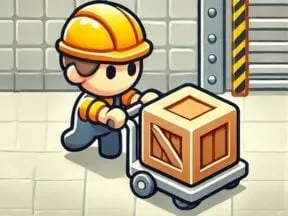
Sokoban is one of the most respected puzzle games ever made — a Japanese design from 1981 whose rules fit in a sentence: you push crates around a warehouse onto marked targets, and you can only push, never pull.
That single restriction is what makes it deep. A crate pushed into a corner is stuck forever, and a crate pushed against a wall can only move along it. Solving a level means seeing several moves ahead to which pushes are irreversible, which is why Sokoban is studied in computer science as a genuinely hard planning problem.
How to play Sokoban
- Move
- Arrow keys or W A S D
- Undo
- Z or the undo button
- Restart
- R
- Walk around the warehouse.
- Walk into a crate to push it — you can never pull.
- Push every crate onto a marked target.
- Complete the level without stranding a crate.
Sokoban tips
- Never push a crate into a corner unless a target is there — it's stuck permanently.
- A crate against a wall can only slide along that wall; plan before committing.
- Solve the crates furthest from your route first.
- Undo freely — recognising a dead position early is the actual skill.
Sokoban — questions
What are the rules of Sokoban?
You push crates onto marked targets and can only push, never pull. Every level is solvable, but many pushes are irreversible — which is the whole difficulty.
Why is Sokoban considered hard?
Because pushes can't be undone in-world, small mistakes make a level unsolvable without a restart. It's studied in computer science as a benchmark planning problem for exactly that reason.
How old is the game?
It dates from 1981, designed by Hiroyuki Imabayashi in Japan, and has been ported and imitated continuously since.
- Categories
- Puzzle
- Platform
- Web browser — desktop, mobile, and Chromebook
- Cost
- Free, no download or sign-up